Magnetostrictive Displacement Sensor Oil Cleanliness and Filter Management
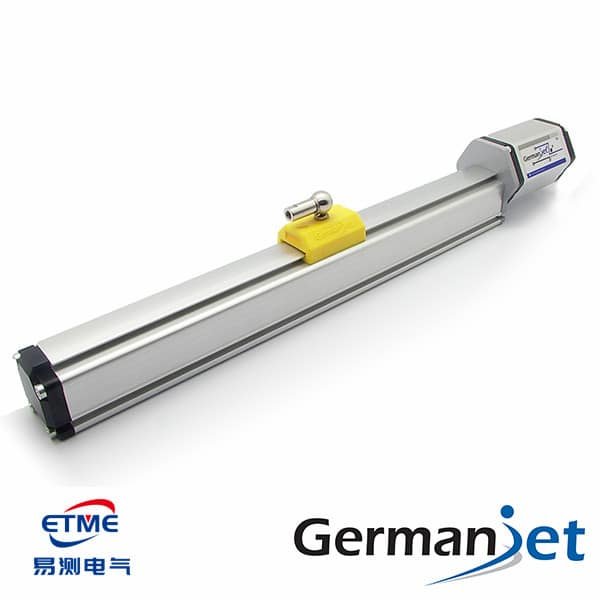
The in-cylinder rod sits in oil for years. No wear parts, but the magnet traps debris and particles scour the tube. Flush first, then manage filters.
Germanjet news, technical articles and resources

The in-cylinder rod sits in oil for years. No wear parts, but the magnet traps debris and particles scour the tube. Flush first, then manage filters.

Before cutting the piston rod: bore over 12.7 mm, depth past full stroke plus dead zone, concentricity held. This hole cannot be reworked once cut.

Jumping magnetostrictive sensor is the commonest complaint; classify first. At rest? Electric fault. Moving? The magnet. Lost frames? The bus.

Shield earthing trips up more sensors than any habit. Analogue loops earth one end at the cabinet; fieldbus shields earth both ends only with bonding.

Add a sensor gateway only when no port matches. It stacks three cycles, adds a fault point and breaks diagnostics; EtherCAT clocks cannot cross it.

Intermittent bus errors are physical-layer, not protocol. Fix it: terminators and linear topology first, then earthing, then routing near welders.

Which fieldbus fits your sensor? Look in the PLC list: CPU port, addable modules, existing backbone. This locks PN, DP and CAN before a gateway.

After a power cut, a fieldbus sensor still knows position from the magnet, no homing. Parameters survive only if stored; CANopen needs a write.

Twenty FAQ on magnetostrictive sensors, one line each: resolution 1 to 100 um, repeatability near 0.002 mm and the 2830 m/s waveguide speed.

Jumpy readings trace back to the magnet, the only moving part. Five fit defects - coaxiality, gap, reversed polarity, loose fasteners, ferrous parts.

IO-Link magnetostrictive sensor frees the last hundred metres: one device per port, then a master sends value and events to PROFINET or EtherCAT.

Start-Stop magnetostrictive sensor pulses on the echo, so the controller times interval by wave speed. Simple wiring, but it needs a fast controller.