Technical Q&A

Jumpy readings, failed communication, drifting zero: each fault has a known cause and a fixed order of checks. Practical sensor troubleshooting.

All Categories

Articles in "Technical Q&A"

Don't Touch the Magnetostrictive Displacement Sensor Yet: Four Layers to Check in Order

Don't Touch the Magnetostrictive Displacement Sensor Yet: Four Layers to Check in Order

When sync drifts out, the two most convenient actions on site are changing control parameters and swapping the magnetostrictive displacement sensor. Both are usually wasted effort. The correct order is bottom-up through four layers: mechanical backlash and distortion, then hydraulic split, leakage, oil temperature and trapped air, then mounting and calibration of the position feedback, and only then control parameters. A ten-minute static versus dynamic split narrows the direction first.

SSI Displacement Sensor Jumps After a Longer Cable: Drop the Clock to Match Length

SSI Displacement Sensor Jumps After a Longer Cable: Drop the Clock to Match Length

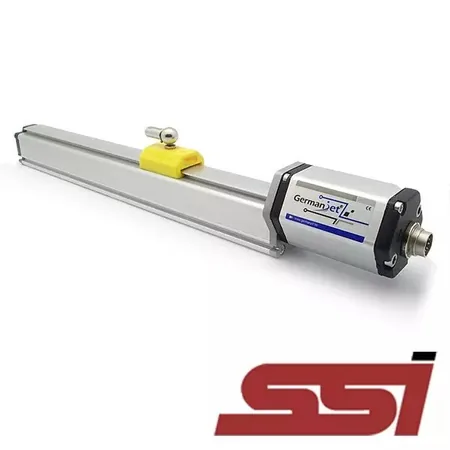
Long SSI cable, then readings jump at rest? Drop the clock on an SSI displacement sensor: 1 MBd fits under 3 m; beyond 200 m it falls to 100 kBd.

Magnetostrictive Displacement Sensor Reading at Zero: End of Stroke or Broken Wire?

Magnetostrictive Displacement Sensor Reading at Zero: End of Stroke or Broken Wire?

Stuck at 0? On 4-20 mA a magnetostrictive displacement sensor still reads ~4 mA at stroke start; an open cable falls near 0, which 0-10 V cannot show.

Magnetostrictive Displacement Sensor: Why the Last Digit Keeps Flickering

Magnetostrictive Displacement Sensor: Why the Last Digit Keeps Flickering

When the last digit of a position reading keeps flickering, do not change the sensor yet. Fast jitter of one or two steps is the normal result of quantisation plus the noise floor; a slow drift over minutes is temperature; a sudden jump of tens of millimetres is interference or a connection problem. Averaging, a first-order low-pass and a dead band can all calm the display, each with its own penalty in lag, phase or lost small movements.

Checking a Magnetostrictive Displacement Sensor with a Multimeter: 5 Steps to Locate the Fault

Checking a Magnetostrictive Displacement Sensor with a Multimeter: 5 Steps to Locate the Fault

No signal? Grab a multimeter first. Five checks—20.4–28.8 V supply, output, head LEDs, insulation, install—pin the fault to supply, body or magnet.

On-Site EMC Fixes for a Magnetostrictive Displacement Sensor: Breaking Source, Path and Victim

On-Site EMC Fixes for a Magnetostrictive Displacement Sensor: Breaking Source, Path and Victim

When the magnetostrictive displacement sensor reading swings, break just one of source, path or victim. This fixes drive, solenoid and weld faults.

Spare-Parts Check of a Magnetostrictive Displacement Sensor: Read the Parameters Across Mechanical, Electrical and Range Layers

Spare-Parts Check of a Magnetostrictive Displacement Sensor: Read the Parameters Across Mechanical, Electrical and Range Layers

'Same series, yet the spare will not fit?' Read magnetostrictive displacement sensor parameters in three layers: flange, output code and stroke.

Acceptance of a Magnetostrictive Displacement Sensor: Arrival Checks and a 10/50/90 Percent Round-Trip Test

Acceptance of a Magnetostrictive Displacement Sensor: Arrival Checks and a 10/50/90 Percent Round-Trip Test

Accept a magnetostrictive displacement sensor twice: on arrival and after install. Skip single-point checks; run a 10/50/90 percent round trip.

Vibration Install of a Magnetostrictive Displacement Sensor: 25 g Is the Body, Anti-Loosening Is the Workmanship

Vibration Install of a Magnetostrictive Displacement Sensor: 25 g Is the Body, Anti-Loosening Is the Workmanship

Vibration faults start at the mount. Series 13 magnetostrictive displacement sensor survives 25 g, yet bolts undo; lock, strain-relieve, re-torque.

M12 Coding and Seals on a Magnetostrictive Displacement Sensor: A, B, D and X Are Not Interchangeable

M12 Coding and Seals on a Magnetostrictive Displacement Sensor: A, B, D and X Are Not Interchangeable

Water enters a magnetostrictive displacement sensor via the M12, even at IP67. A, B, D and X coding is not interchangeable; match coding, keep seals.

Redundant Install of a Magnetostrictive Displacement Sensor: How to Compare Two Readings So It Actually Works

Redundant Install of a Magnetostrictive Displacement Sensor: How to Compare Two Readings So It Actually Works

Redundancy compares two live magnetostrictive displacement sensor readings, not a cabinet spare. Set the alarm window above their mutual deviation.

Commissioning a Magnetostrictive Displacement Sensor: Use a Test Magnet to Split Body Faults from Install Problems

Commissioning a Magnetostrictive Displacement Sensor: Use a Test Magnet to Split Body Faults from Install Problems

Body bad or install wrong? Take a magnetostrictive displacement sensor off-line, feed 24 V, sweep a known magnet; a smooth read proves it sound.

Multi-Axis Synchronisation of Magnetostrictive Displacement Sensors: A Common Reference, One Range and Time Alignment

Multi-Axis Synchronisation of Magnetostrictive Displacement Sensors: A Common Reference, One Range and Time Alignment

For multi-axis synchronisation, pick a magnetostrictive displacement sensor by shared-range consistency, not best single accuracy. Set a common datum.

Magnetostrictive Displacement Sensor: Bus Data Loss, Three Causes

Magnetostrictive Displacement Sensor: Bus Data Loss, Three Causes

Dropped fieldbus values are missing frames, not bad readings. Read master counters, then inspect 120 ohm ends, repeated node IDs and wet M12 plugs.

High-Temperature Install of a Magnetostrictive Displacement Sensor: Block Radiation, Split-Mount, Choose Cable

High-Temperature Install of a Magnetostrictive Displacement Sensor: Block Radiation, Split-Mount, Choose Cable

Heat ages a magnetostrictive displacement sensor near its rating limit. Split ambient, oil and radiant heat; move the head clear of the hot zone.

Hazardous-Area Wiring of a Magnetostrictive Displacement Sensor: The Three Elements of an Intrinsically Safe Loop

Hazardous-Area Wiring of a Magnetostrictive Displacement Sensor: The Three Elements of an Intrinsically Safe Loop

Ex ia is a loop, not a rating on a magnetostrictive displacement sensor. Pair certified device, barrier and approved cable; IP68 alone is not enough.

Long Cable Runs of a Magnetostrictive Displacement Sensor: Voltage Drop, Attenuation and Repeater Segmentation

Long Cable Runs of a Magnetostrictive Displacement Sensor: Voltage Drop, Attenuation and Repeater Segmentation

Distance is no enemy on a long run. What limits a magnetostrictive displacement sensor is supply drop, fade and noise; pick 4-20 mA plus a repeater.

External Mounting of a Magnetostrictive Displacement Sensor: Bracket and Slider

External Mounting of a Magnetostrictive Displacement Sensor: Bracket and Slider

An external sensor leans on its bracket and slider. Keep the chain axial-only: rigid datum, parallel rail, floating slider. This tests bracket flex.

Magnetostrictive Displacement Sensor: No Output in Three Checks

Magnetostrictive Displacement Sensor: No Output in Three Checks

A magnetostrictive sensor with no reading points to one broken link. Do not open the head: check +24 V at the plug, trace the loop, move the magnet.

Magnetostrictive Displacement Sensor Zero Calibration, Done Right

Magnetostrictive Displacement Sensor Zero Calibration, Done Right

Calibrate a magnetostrictive sensor once, not daily. Pick a fixed reference, take both ends, solve the slope, then check mechanics and magnet fit.

Magnetostrictive Displacement Sensor: Reading Errors in Four Shapes

Magnetostrictive Displacement Sensor: Reading Errors in Four Shapes

Output misses true position? Take three points: 10, 50 and 90 percent of travel. Steady offset is zero, widening is span, a local dip is the magnet.

Magnetostrictive Displacement Sensor Oil Cleanliness and Filter Management

Magnetostrictive Displacement Sensor Oil Cleanliness and Filter Management

The in-cylinder rod sits in oil for years. No wear parts, but the magnet traps debris and particles scour the tube. Flush first, then manage filters.

Cylinder Bore Rule for a Magnetostrictive Displacement Sensor: 12.7 mm

Cylinder Bore Rule for a Magnetostrictive Displacement Sensor: 12.7 mm

Before cutting the piston rod: bore over 12.7 mm, depth past full stroke plus dead zone, concentricity held. This hole cannot be reworked once cut.

Magnetostrictive Displacement Sensor Signal-Jump Troubleshooting Flow

Magnetostrictive Displacement Sensor Signal-Jump Troubleshooting Flow

Jumping magnetostrictive sensor is the commonest complaint; classify first. At rest? Electric fault. Moving? The magnet. Lost frames? The bus.

Magnetostrictive Displacement Sensor Shield: One End or Both

Magnetostrictive Displacement Sensor Shield: One End or Both

Shield earthing trips up more sensors than any habit. Analogue loops earth one end at the cabinet; fieldbus shields earth both ends only with bonding.

FAQ Round-Up: 20 Common Questions About Magnetostrictive Displacement Sensors, Answered

FAQ Round-Up: 20 Common Questions About Magnetostrictive Displacement Sensors, Answered

Twenty FAQ on magnetostrictive sensors, one line each: resolution 1 to 100 um, repeatability near 0.002 mm and the 2830 m/s waveguide speed.

Five Magnet-Fit Pitfalls on a Magnetostrictive Displacement Sensor

Five Magnet-Fit Pitfalls on a Magnetostrictive Displacement Sensor

Jumpy readings trace back to the magnet, the only moving part. Five fit defects - coaxiality, gap, reversed polarity, loose fasteners, ferrous parts.

Baidu
map