Technical Articles & News

Principles, selection, installation, wiring, accuracy and troubleshooting — plus typical applications in injection molding, hydraulics, wind power and steel.

Latest Technical Articles

Why One Divider Valve Cannot Keep Two Cylinders Together: Four Errors Open Loop Never Corrects

Why One Divider Valve Cannot Keep Two Cylinders Together: Four Errors Open Loop Never Corrects

Two cylinders push the same beam. The command is identical, the valves are identical, and the beam still runs crooked. The problem is not tuning. A divider valve synchronises by splitting flow, and with no position value anywhere in the circuit four errors stay uncorrected: the flow split itself, flow shifting under asymmetric load, oil compressibility, and internal leakage plus oil temperature drift. The position difference keeps accumulating along the stroke until something else stops it.
Mechanical, Divider Valve or Servo Closed Loop: Choosing Between Three Ways to Sync Cylinders

Mechanical, Divider Valve or Servo Closed Loop: Choosing Between Three Ways to Sync Cylinders

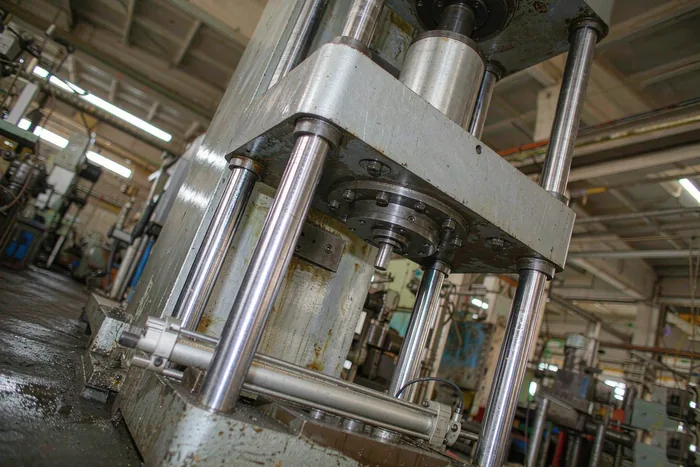
Every multi-cylinder sync scheme reduces to one of three: enforce it with structure, split the flow, or close a loop on position. All three work, in different territory. Mechanical sync is easiest when spans are short and strokes are small, a divider valve is enough when the load is symmetric and the tolerance loose, and servo closed loop becomes unavoidable once the load is asymmetric or the tolerance reaches a few parts in a thousand. A three-step test decides which applies.

Don't Touch the Magnetostrictive Displacement Sensor Yet: Four Layers to Check in Order

Don't Touch the Magnetostrictive Displacement Sensor Yet: Four Layers to Check in Order

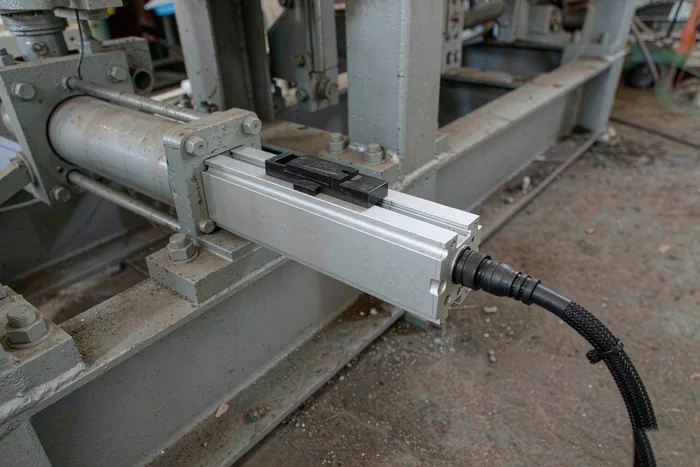
When sync drifts out, the two most convenient actions on site are changing control parameters and swapping the magnetostrictive displacement sensor. Both are usually wasted effort. The correct order is bottom-up through four layers: mechanical backlash and distortion, then hydraulic split, leakage, oil temperature and trapped air, then mounting and calibration of the position feedback, and only then control parameters. A ten-minute static versus dynamic split narrows the direction first.

Anti-Vibration Mounting Clips for Injection Moulding Sensors: 42.5 mm Hole Pitch, 3.5 kgf·cm Torque, 13 Steps

Anti-Vibration Mounting Clips for Injection Moulding Sensors: 42.5 mm Hole Pitch, 3.5 kgf·cm Torque, 13 Steps

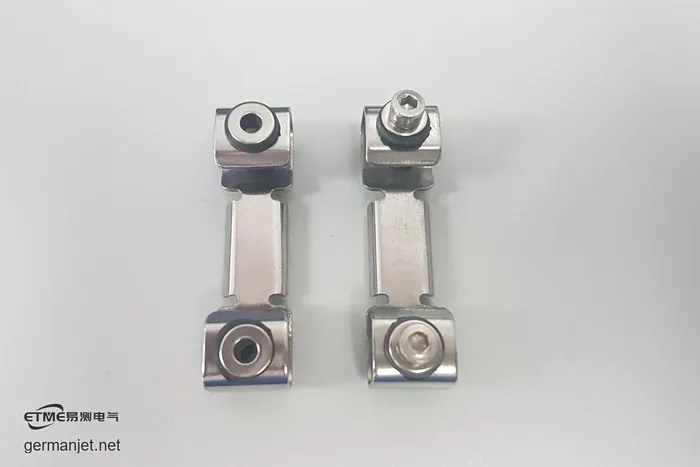
Both sensors on an injection moulding machine — clamp and injection — are isolated by a pair of anti-vibration mounting clips. The original factory guide turns on two numbers that have not changed in over a decade: a 42.5 mm hole pitch and a tightening torque of 3.5 kgf·cm. Torque has to be applied with a slipping-type driver and stopped at the click — too much crushes the elastomer, too little leaves the screw unseated. Each pack contains two clips and four washers, and not one washer can be skipped. The guide closes with the two site causes of a driver that clicks without clamping: a broken tap left in the hole, or poor thread quality.

Ten Injection Presses, One Jittering Ejector Sensor: A Thin Mounting Plate Acting as a Tuning Fork

Ten Injection Presses, One Jittering Ejector Sensor: A Thin Mounting Plate Acting as a Tuning Fork

We ran all ten injection moulding machines on site up to maximum ejector speed. Only one reading jittered; the other nine stayed steady. The cause was not the sensor: on that smaller machine the mounting plate was not rigid enough and too thin, so at speed the plate resonated like a tuning fork and fed high-frequency vibration down the cantilever into the sensor core. A replacement sensor would not have helped. Fitting an anti-vibration base cleaned the waveform immediately. A second, separate fault turned up in the same batch: installation over-travel, with the slider passing the black mark on the housing at the bottom of the stroke on several machines.

LK 3500-Ton Press: 6 mm Jitter on a 3800 mm Analog Sensor

LK 3500-Ton Press: 6 mm Jitter on a 3800 mm Analog Sensor

On an LK 3500-ton injection moulding machine a 3800 mm analogue sensor showed 6 mm of jitter. A 6.5-digit voltmeter and a 3 V battery split sensor, cable, controller and display section by section: the sensor itself jittered only 0.0005 V, about 0.19 mm. The 6 mm came from a bundled cable run, poor machine earthing and door-drive interference.

Magnetostrictive Displacement Sensor Applications: Cylinders, Moulding Machines, Rolling Mills

Magnetostrictive Displacement Sensor Applications: Cylinders, Moulding Machines, Rolling Mills

Where magnetostrictive displacement sensors are used: built into hydraulic cylinders on injection moulding, die casting and press machines; mounted externally on a bracket for rolling mill roll gap, press brake rams and gate openings; and on tunnel boring machines, where dozens of thrust cylinders have to be read at once. The common demand is accuracy, non-contact measurement and resistance to oil, dirt and vibration. Advantages: no wear, high accuracy, long stroke. Limitations: higher cost than a conductive-plastic electronic ruler, and a built-in sensor means work on the cylinder body.

SSI Displacement Sensor Wiring: Output Signals and How to Fix the Output at Selection

SSI Displacement Sensor Wiring: Output Signals and How to Fix the Output at Selection

SSI is a synchronous serial digital output: clock plus data, no supply carried in the signal pair, and not a fieldbus. It can only be read by a PLC high-speed counter card or a dedicated SSI interface, and it cannot be converted to 4-20 mA or to a bus the way an analogue signal can. The right move is to fix the output type during selection — 4-20 mA or 0-10 V for an analogue input module, CANopen, Profibus-DP, EtherCAT or Profinet for a bus. The article ends with the correct four-wire 4-20 mA connection.

Displacement Sensors in Five Heavy Industries: Die Casting, Curing, Bending, TBM, Steel

Displacement Sensors in Five Heavy Industries: Die Casting, Curing, Bending, TBM, Steel

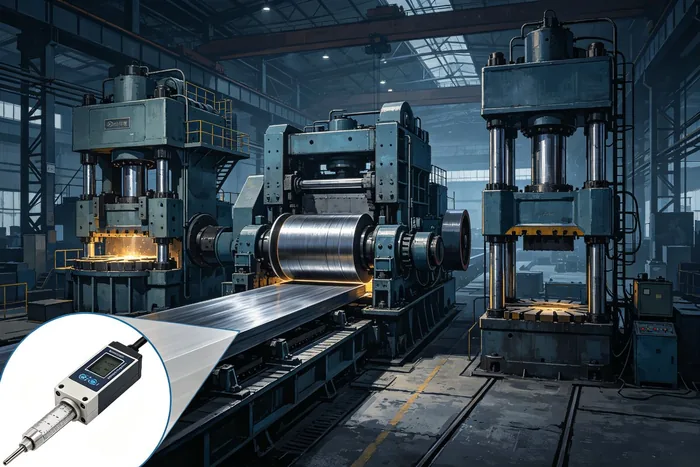
Five heavy industries measured by displacement sensors: a die casting machine tracks injection and clamping stroke, a curing press tracks platen opening, a press brake tracks ram descent, a tunnel boring machine tracks thrust cylinders and segment attitude, and a steel mill tracks roll gap and the lifting table. Each section covers the working principle, the measuring position, the wiring and the selection points, plus on-site mounting and maintenance advice.

Injection Moulding Machine Displacement Sensor: Three Ruler Positions and Wiring

Injection Moulding Machine Displacement Sensor: Three Ruler Positions and Wiring

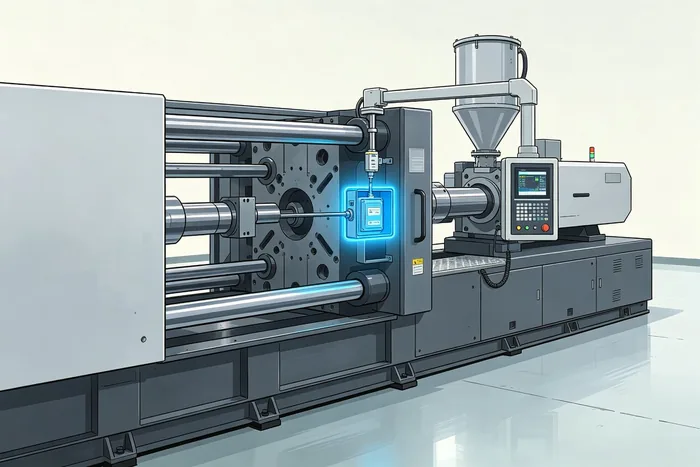
Where displacement sensors go on an injection moulding machine: mould clamping, ejection and injection each need one electronic ruler, and the stroke, output type and mounting differ per axis. The article gives the wiring diagram and the steps from installation through to production, and explains what changes when an ordinary electronic ruler is replaced by a magnetostrictive sensor on the clamping and injection axes.

Hydraulic Cylinder Displacement Sensor Faults: Three-Step Test and Solutions

Hydraulic Cylinder Displacement Sensor Faults: Three-Step Test and Solutions

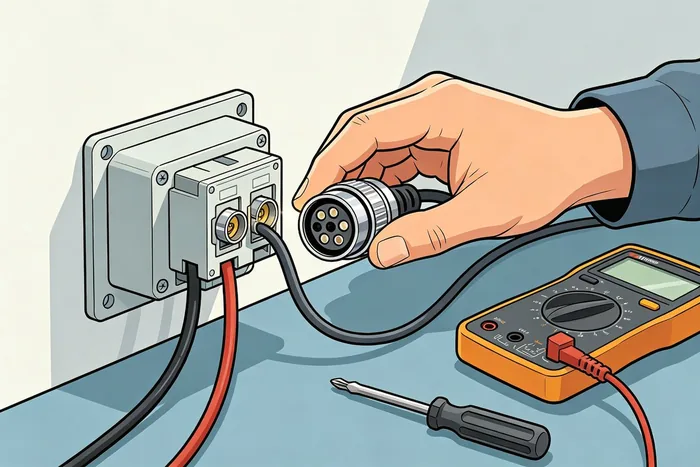
Troubleshooting a hydraulic cylinder displacement sensor starts with a three-step good-or-bad test that needs only a multimeter: check the supply voltage, then the signal output, then the insulation between windings and housing. A reference table covers jumping readings, no output, drift and shorted signals with the likely cause and the fix, followed by the replacement procedure to use once a failure is confirmed rather than assumed.

Hydraulic Cylinder Displacement Sensor: Principle, Wiring, Mounting, Parameters

Hydraulic Cylinder Displacement Sensor: Principle, Wiring, Mounting, Parameters

A full guide to hydraulic cylinder displacement sensors: why the built-in magnetostrictive type is used, how the magnet ring rides with the piston and position is measured without contact, how to wire analogue four-wire and digital outputs, the four mounting rules for an oil cylinder, and how to set stroke, zero and direction. Includes a parameter table for built-in cylinder series and points to compare when choosing a brand.

Baidu
map